Monday, 17 April 2023

Where do you get your ideas? : ISLAND LIFE

GET IT HERE

All my work starts with an image, like a photograph. It arrives in my head, then starts to run like a movie, and the story builds from there. Sometimes the image is from the end of a story, and I have to run it backwards, but everything is done visually at the start. 

A while back, I came across a lighthouse on an island.

Over thirty years ago, I was on Lundy Island for a mate's 30th Birthday. We had a great time in the wee local bar, appeared on Channel 4 who were there at the time with us pretending, stiffly, to be locals, and stayed in a converted lighthouse set next to a burial ground and a neolithic chambered tomb. Much fun was had negotiating a piss off the top of the lighthouse while drunk after midnight, and dealing with the wailing banshee that lived in the stairwell.

I have a deep love of old places, in particular menhirs and stone circles, and I've spent quite a lot of time travelling the UK and Europe just to visit archaeological remains. I also love what is widely known as weird shit. I've spent far too much time surfing and reading Fortean, paranormal and cryptozoological websites. The cryptozoological stuff especially fascinates me, and provides a direct stimulus for a lot of my fiction.

I lined up the photograph to have standing stones in the foreground and the lighthouse in the background. Then I started to wonder who would live in the lighthouse and what was under the standing stones, and a story began to run. That turned, eventually and more than ten years later, into my first novel, "Island Life" and, as a bonus, the publisher agreed to my picture of the lighthouse being used on the cover, so it went full circle.

I love monsters....especially black and white ones with the zips showing. Treat this novel like a fifties monster flick and you'll have a great time with it.

The book was out of print for many years, but is now available again in print, ebook and audiobook from Gryphonwood Press.


Sunday, 16 April 2023

Where do you get your ideas? : THE INVASION


THE INVASION reached no 2 in both Kindle SF and Kindle Horror and has sold over 20,000 copies.

I nearly didn't bother writing it.

The first science fiction I ever encountered was Fireball XL5, one of the early Gerry Anderson productions. I was only about four years old, but I was hooked immediately on spaceships and adventure in the stars.

I grew up during the exciting part of the space race, staying up nights to watch space-walks then moon missions, eyes wide in wonder as Armstrong made his small step.

At the same time Gerry Anderson had continued to thrill me, with Stingray, Thunderbirds and Captain Scarlet. The Americans joined in, with Lost in Space then, as color TV reached Scotland, Star Trek hit me full between the eyes.

Also at the same time, my reading was gathering pace. I'd started on comics early with Batman and Superman. As the '60s drew to a close, Marvel started to take over my reading habits more, and I made forays into reading novels; Clarke and Asimov at first, and most of the Golden-Age works. By the early Seventies I had graduated to the so-called New Wave, Moorcock, Ellison, Delaney and Zelazny dominating my reading, and they led me on to reading, then writing horror.

I more or less stopped reading Science Fiction round about then, but I never stopped watching, especially after Star Wars gave the visual genre a huge push forward. I re-discovered the '50s classics after the advent of the VCR and quickly built a huge collection of movies, many of which I still watch avidly.

Which brings me, in a long winded manner, to The Invasion. Invasions, and the resulting carnage, have always loomed big in my favorites of the genre, through War of the Worlds, Earth vs Flying Saucers, the original V series and even the spectacular failure of Independence Day. Neil Jackson asked me if I was interested in writing a four-part serial, and laid out a basic timeline. I ran with it, and soon discovered that I had a story to tell.

To regresss slightly, another part of my early reading, and the one that united my Science Fiction reading with my horror reading, was the works of H P Lovecraft. I realised that the Invasion in my story would have Lovecraftian antecedents, in that it would come from space, and be completely uncaring of the doings of the human race. My training as a biologist also made me realise that aliens should be -really- alien, not just simulcra of pre-existing terrestrial forms. Once I had that in my mind, it didn't take much to come up with a "color out of space" that would engulf the planet.

Most Invasion movies concentrate on the doings in big cities, and with the involvement of the full force of the military. I wanted to focus more on what it would mean for the people. Living as I am in Canada, in a remote Eastern corner, I was able to draw on local knowledge and home in on people already used to surviving in extreme conditions. I just upped the ante.

An interest in conspiracy theories and post-apocalypse survivalists also gave me one of the main characters, and the early parts of the story are a news report from the bunker where he has retreated to ride out whatever is coming. So come with me, to a winter storm in the Maritimes, where a strange green snow is starting to fall.


Saturday, 15 April 2023

Where do you get your ideas?: THE VALLEY


The origins of "The Valley" are pretty simple to trace. In Fortean circles there have been attempts to find a picture that many claim to have seen, yet no-one has been able to find. This fabled photograph is said to show a group of Civil-War era men standing in a row wearing big grins. Spreadeagled on the ground in front of them is the body of a huge bird, a being that could only come from pre-history. In some accounts this bird is a giant eagle, in others it is even stranger, a leathery, paper thin Pterosaur.

Whatever the case, that image was the thing in my mind, and I had a "What if..." moment, wondering what would happen if cowboys came across a Lost World. From that single thought, the initial concept of The Valley was born.

There's a long tradition of Lost World tales, both in movies and fiction. Over the years I've devoured as many as I can find, from Conan Doyle through Haggard, from Tarzan in Pellucidar to Doug McLure in the Land that Time Forgot. Many of these tales involve dinosaurs, but I wanted something different.

For a while I didn't know exactly what "creatures" I needed, but that all changed as soon as the setting clicked. Back in 2005 I had the good fortune to holiday in the Rockies. It was while scanning through photographs of that trip that the thought of the high mountain valley came to me, and when Neil Jackson told me about Montana and the Big Hole Valley, I knew I'd found my spot.

And the pictures of the ice and snow from my trip also gave me the era from which I would draw my creatures -- the last Ice Age. I now knew that my protagonists would be heading into a Lost Valley where relic animals lived, and that these creatures would be hairy and large. I had an image of a herd of mammoths by a partially-frozen lake, and that was the image that drove me on in the early concepts.

Now I needed some protagonists. I knew in advance I wanted to write a "western" and some research led me to set the story in the 1860s, when something of a mini-goldrush was happening in Montana. The characters grew on me quickly. I wasn't too surprised at that -- my early childhood was steeped in Westerns. I have my Granddad to thank for days watching Wagon Train, Rawhide, Bonanza and Gunsmoke, then later on, The Virginian and The High Chapparal. He also introduced me to Louis L'Amour and others as I devoured his collection of Western paperbacks.

As I started the Valley I already knew that I was going to have six men thrown into peril, and that they'd be almost evenly split between white and black hats. Several of them surprised me as the story went on, but from the start they had a "depth" that reassured me that the story would go to all the right places.

I got them to the mining camp, and the start of the aforesaid perils. Then my muse threw a spanner in the works. I've been a Ray Harryhausen fan most of my life, and the creature that now came to mind was a Harryhausen special, one that I could "see" in my mind's eye, scuttling and "snipping". Unfortunately it didn't exist in the Ice Age, but at a time much longer ago. But I wanted it, so in it went. I won't give the plot away here, but suffice to say I managed to fit it in -- I managed to fit a lot of them in. And as a result the rest of the story immediately fell into place, almost as if I was channeling a new Harryhausen movie.

I wrote the whole thing in less than ten days, my brain thinking about little else the whole time. It's one of the most fun experiences I've ever had writing, and I hope it shows in the final product. Even now, years after finishing it, I still find myself thinking about the Valley, and the creatures that inhabit it. I even wrote a sequel, of sorts, in my Professor Challenger collection, where the Prof journeys to the same valley some fifty years later. And somewhere, the story still continues. One day I might go back to find out what happened next.


Friday, 14 April 2023

Where do you get your ideas? : FUNGOID


In this one you'll find a chunk of Newfoundland, a fireman, some nasty rain, a bit of real science, a lot of unreal science, some Canadians, many cigarettes, some trucks, boats and planes, and plenty of spores, mushrooms and rot.

For fans of John Wyndham, William Hope Hodgson and H P Lovecraft, here’s a wee homage to a lot of the things I’ve loved since childhood.

Something a lot of people don’t know about me: I used to be a botanist. And no, it doesn’t mean I know about gardening. For my honors thesis I studied how much archaeological information could be gleaned from analyzing pollen grains in the strata of peat bogs in Central Scotland, I spent a year after graduating cataloging the plant fossil collection in the Hunterian Museum in Glasgow, and I had an abortive attempt at doing a PhD in the causes of rot in apples as they ripen.

I also learned quite a lot about fungi. The pollen analysis stuff hasn’t made it into a story of mine yet, but the fungi have – there’s something insidious about the creeping of mycelium, something obscene in the flesh of the caps, something scary in the fact that they spend so much time in the dark, just sitting there… growing.

I started to get a germ (or should that be spore ) of an idea a few years back of a fungal takeover of the planet, and I tried it out in a piece of flash fiction that I sold to NATURE FUTURES ( you can read that one–> here. ) It was the one image I had in mind, of a dark sky and vast, endless fields of high fruiting bodies. The image wouldn’t leave me, and it came back in another story, THE KEW GROWTHS, in my Challenger collection where the Prof has to tackle a giant fungal menace threatening London.

That story was fun – but the image I had in my head was still for something a lot darker – something insidious, obscene and scary.

Then another, accompanying, image came – a man in a HAZMAT suit, with nothing inside that was remotely human, just creeping filaments and bursting spores.

The story begins with spore-filled rain over Newfoundland. I’ve trashed my new homeland in this book. Sorry.

Thursday, 13 April 2023

Where do you get your ideas? : THE GREEN AND THE BLACK


It’s a question all writers have heard. And in the case of my book, The Green and The Black, I didn’t fully realize where it had come from while I was writing it. A chunk of it takes place in a Newfoundland hospital. It was only on reading it back during editing that I realized how much of a recent personal experience had seeped in to the writing.

Back on Easter Saturday of 2017, my wife and I got out of bed, and she said she wasn’t feeling great. By the time we got out of the bedroom and along the landing she was teetering, and I reached her just as she fell at my feet.

She wasn’t breathing, and her eyes had gone glassy, like the dead blue eyes of a china doll. I really thought I’d lost her.

I got her rolled over and thumped her on the chest, twice, while screaming in her face. That did the trick, and her eyes fluttered, took on life and she was back, at least some of the way, although she was still not able to respond to me and couldn’t focus.

I phoned 911, an ambulance came after what seemed like an age, and some big burly chaps carted her off to our local ER, about 10 miles away. I followed, still shaking like a leaf, in the car.

To cut a long story short, and condense hours of worry into a few words, she had pulmonary embolisms in both lungs. The docs told me that 1 in 3 people who get them like that just die straight off, so we were lucky, in a way.

There followed two weeks of visiting her as she lay in a recovery ward. She was fully back and awake after a few hours, but the recovery was long as they fed her oxygen and blood thinners to try to get her lungs functioning somewhere near normal,

So that’s the background. The thing that seeped into my book wasn’t my wife’s illness though, it was the quiet professionalism, good cheer, and humanity of the medical and nursing staff, all of them heroes in my eyes.

As I read through my edits I saw that I’d captured some of that stoic quiet, and some of the atmosphere of how hospital staff go about immersing patients in an environment designed to make them calm, and give them time to heal.

There’s not much calm in the final book, but that’s not the hospital staff’s fault. The Green and the Black is something they have never seen before, something old that gets inside folks, and festers, thickens and grows.

Obviously, again, the disease in the book echoes in some ways the clots in Sue’s lungs, and again I didn’t see that until the edits. But my subconscious obviously knew what it was doing.

There was a nurse in that local hospital who sang ditties to herself as she went about her business. That too resurfaced in the book and again in a more sinister fashion, with an old children’s song I used as a recurring motif every time the supernatural made an entrance.

Other things in the mix came from my childhood. It was originally going to be about Kobolds, the goblinesque things that knock in coal mines.

Goblins in the deep places have haunted my dreams since a first read of THE HOBBIT, way back in 1968, and I’ve long wanted to do a modern times novel with them at the center of things. I started one a while back, but that fizzled out and ended up as a story in Dark Melodies. And similarly, when I got to the point for the reveal, there was something else behind the curtain.

The wee folk who turn up drinking and singing in the mines and the camp are close cousins to goblins of course, but give off the appearance of being something more jolly, at first glance at least.

I dredged these ones up out of some old Scottish tales originally, of people being trapped in fairyland after overindulging in booze and song and dance at the wee folks’ party.

And then things took an even darker turn, when I realized what song it was they were always singing in my story. I have my auld grannie to thank for all the snippets of folk songs, lullabyes, show tunes and hymns that provide me with regular earworms.

The dolls of stick, leaf and branch that became a motif throughout likewise came from old stories from home. Originally, they were going to be scarecrows, with goblins inside, but they too took another turn, when I realized the wood and leaf was still alive, still capable of taking root, and growing.

Some of my family did spells as coal miners, back in the auld country, and their tales too found their way in into the mix, of friendship and bonds, of dark places and sudden deaths.

Mix all of that in with some of my botany and archaeology experience and you can see that THE GREEN AND THE BLACK came from a soup of influences.

It's one of my favorite things I've written.

GET IT HERE

Monday, 10 April 2023

Shall We Talk About the Black Bird?


The black bird has been with me for a long time – 50 years and more now.

I think I first saw The Maltese Falcon in around 1965.

My granddad was a big Bogart fan, and I remember long Sunday afternoons spent sitting at his feet watching movies on the tiny black and white TV that was the norm back in the UK in the early Sixties. Back then everything was Britain was still in black and white – the Beatles were about to change all that, but Bogey would stay eternally gray and eternally Sam Spade for me. Even at that early age there was something about the snappy dialogue and the larger than life character that spoke to me.

I saw the film several times before I got round to reading the book – aged around 12 so about 1970. In much the same way as the film had, the book also spoke to me, touched something in me – the stuff that dreams are made of if you like.

When I started writing for myself, back in school, my voice was heavily influenced by teenage longings – I hadn’t learned enough of the ways of the world to be confident and sparse, I wanted to be flowery and intense and intellectual.

University, then ten years of being a corporate drone quickly drummed that nonsense out of me. I developed cynicism and from that my own voice started to emerge, enough to ensure I could cope with being an adult but not yet enough to turn me into a writer.

The booze did that. Booze and nightmares and a new wife that understood me better than I did myself.

The booze is part and parcel of being brought up in a working class environment in the West of Scotland. Beer came easy to me in my late teens, a love affair I still have to this day. Whisky I had to work a little harder at, but I persevered and developed a taste for single malts that means my habit is largely curtailed by the expense. It doesn’t mean I don’t get the thirst though.

The nightmare? I’ve been having it off and on since I was a boy. It’s of a bird – a huge, black, bird. The stuff that dreams are made of.

In the nightmare I’m on the edge of a high sea cliff. I feel the wind on my face, taste salt spray, smell cut grass and flowers. I feel like if I could just give myself to the wind I could fly. Then it comes, from blue, snow covered mountains way to the north, a black speck at first, getting bigger fast. Before I know it it is on me, enfolding me in feathers. It lowers its head, almost like a dragon, and puts its beak near my ear. It whispers.

I had the dream many times, and always woke up at this point.

Then, in 1991, I heard what it said.

“Will we talk about the black bird?”

The next morning, for the first time since 1976, I wrote a story. It wasn’t a very good story, but something had been woken up, and the day after that I wrote another, a wee ghost story. It didn’t have a black bird in it, but it did have some jazz, and a sultry broad, a murder and some dancing. When that one made me 100 pounds in a ghost story competition, I was on my way.

The bird comes back and whispers to me every couple of years – I’ve come to think of it as my spirit guide. Although it terrifies me, it also reassures me in a weird kind of way. As long as it’s around, I’ll still be a writer and not just a drunk with weird ideas he can’t express.

One of the bird’s recent appearances was a few years back, and the next morning I had an idea that fused my own history, my favorite movie and my bad habits into one coherent whole – BROKEN SIGIL is the most personal thing I’ve ever written. It’s also among my favorites of all my works.

Will we talk about the black bird?


Sunday, 9 April 2023

My Newfoundland Fiction


Newfoundland is worming its way more and more into my soul, and out again in my writing.

When I started writing in the ’90s in Scotland most of my stories were set either there, or in London where I spent the ’80s. I appear to need to be tied to a sense of place for work to come easily. With Newfoundland, the ties fell into place naturally.

We came over on holiday in 2005, primarily on a whale watching trip to Trinity, and fell in love immediately with the area. There is much here that reminds me of home, in both the maritime landscape, and the warmth of the people, and although they’re mostly of Irish descent around here, I felt an immediate kinship with their stories of ekeing a living out of a harsh sea, as it’s something my own family have much experience of on the opposite side of the same ocean.

When my IT job in Edinburgh went tits-up in 2007, I’d had just about enough of working for the man after 25 years of wearing a suit and commuting into busy cities, having worked in London, Aberdeen and Edinburgh. I talked to my wife, Sue, about the possibility of downsizing totally, and it was just when I was starting to get some serious pro-level story sales. We knew from our holiday that we could get a nice house with a great view dirt cheap (compared to Scottish prices ) over here on The Rock. So we sold up in Scotland, whacked some money in the bank, bought a house on the shore here, and I tried writing full time. I’ve not starved us yet, more than fifteen years down the line.

We chose Catalina, a fishing town up on the Bonavista Peninsula. It’s a long way from any kind of night life, bookshops or cinemas, but it’s not quite in the middle of nowhere. We have roads, a post office, a supermarket and some takeaway places. We even have running water and electricity. The people are very friendly, as I said earlier, mostly of Irish descent around here, and it’s lovely and quiet, which suits me just fine.

The local accent here is very strong, and strange on the ear at first, but I’ve come to understand most of the people well enough, although there are still a few old timers in the town who leave me completely baffled, and we communicate mainly by smiles, hand-gestures, and nods of the head.

We have an open view across a wide bay, the opening of which is out onto the Atlantic, we have whales out there, moose and bear in the hills, bald eagles overhead and squirrels in the garden, as well as the ever shifting moods of the bay itself. It’s not a bad way to live.

It also seems to suit my writing. As I said earlier, the ties to the landscape fell into place quickly. The third Derek Adams book, THE SKIN GAME was stalled in its opening act back in Scotland and I hadn’t been able to get past a blockage, but that first winter after we got here I realised that if I could come to Newfoundland, then Derek, The Midnight Eye and protagonist, could come here too. After that the rest of that one fell quickly into place and a pack of Scottish werewolves howled at the moon under a Newfoundland sky.

After that I wrote a handful of short stories set on The Rock, testing the waters as I let the place seep into my soul. It’s got its hooks deep in me now. My home will always be Scotland, but The Rock has my heart and soul on loan in the meantime.

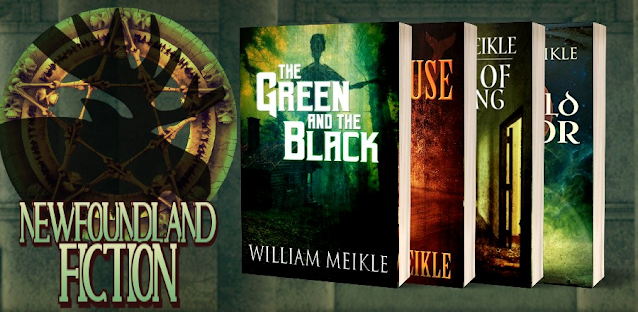
Since those early short stories I’ve been exploring various parts of the island and its culture in my novels. THE DUNFIELD TERROR takes place around Trinity, where I spent my first year here working on a whale tour boat, FUNGOID takes place in the island capital St. Johns, and also up this peninsula where I live while SONGS OF DREAMING GODS is set in a corner townhouse in St. John’s again. THE BOATHOUSE is set here in our home port of Catalina, and THE GREEN AND THE BLACK is set in a derelict Victorian mining colony in the island’s interior.

There will be more, as I haven’t covered the whole glorious gamut of this place yet.

And I still need to get a moose in somewhere.

If you’re at all intrigued by any of this, check out the books. You never know, you might fall in love with the place too.

INTRODUCTION


I'm a sixty-something Scottish lad from Ayrshire originally. I'm a graduate of Glasgow University, in Botany, after which I had a career in IT in London, Aberdeen and Edinburgh before leaving the rat race behind. I now live in a small fishing town on the eastern side of Newfoundland on the Atlantic shore with whales, bald eagles and icebergs for company.

I didn't chose writing, it chose me. The urge to write is more of a need, a similar addiction to the one I used to have for cigarettes and still have for beer. It's always been there, in the background. I wrote short stories at school, and dabbled a couple of times over the years, but it wasn't until I was in my 30s that it really took hold. 

Back in the very early '90s I had an idea for a story... I hadn't written much of anything since the mid-70s at school, but this idea wouldn't leave me alone. I had an image in my mind of an old man watching a young woman's ghost. That image grew into a story, that story grew into other stories, and before I knew it I had an obsession in charge of my life.

So it all started with a little ghost story, "Dancers"; one that ended up winning a prize in a national ghost story competition, getting turned into a short movie, getting read on several radio stations, getting published in Greek, Spanish, Italian and Hebrew, and getting reprinted in The Weekly News in Scotland.

Since then I've sold over 300 short stories, including appearances in the likes of NATURE and THE WEEKLY NEWS among many others, and I've had over 30 novels published in the horror and fantasy genre presses in the USA, with more coming over the next few years. 

I went full time in 2007. Haven't starved us yet.


The biggest influences on my particular style of writing would have to be the reading I did as a teenager in Kilbirnie in the early-seventies, before Stephen King and James Herbert came along. I graduated from Superman and Batman comics to books and I was a voracious reader of anything I could get my hands on; Conan Doyle, Alistair MacLean, Michael Moorcock, Nigel Tranter and Louis D'Amour all figured large.  Pickings were thin for horror apart from the Pan Books of Horror and Dennis Wheatley, which I read with great relish. Then I found H P Lovecraft and things were never quite the same.  

Mix that with TV watching of Thunderbirds, Doctor Who, the Man From Uncle, Lost in Space and the Time Tunnel, then later exposure on the BBC to the Universal monsters and Hammer vampires and you can see where it all came from. Oh, and Quatermass. Always Quatermass. 

A lot of my work is still particularly Scottish though. My series character THE MIDNIGHT EYE is a Glasgow PI who gets involved with the occult and monsters. He works out of a flat above Byres Road, smokes like a lum and drinks like a fish. I have a lot of fun with him and he appears in three books and numerous short stories and novellas of mine. 

My current work is largely focused on creature features, in particular the S-SQUAD series from Severed Press. The series is up to book #1, 8with more coming, and features a team of sweary Scottish squaddies facing up to big beasties around the world. Think Dog Soldiers meets Aliens through a Ray Harryhausen lens and you'll get a feel for them.


If you're in the mood for something shorter, I've self-published over 80 chapbooks on Amazon Kindle ( free on Kindle unlimited) that showcase the whole range of my work over the years. There's something for everyone here; Scottish supernaturals, Lovecraftian horrors, Holmes and Carnacki pastiches and novellas not available anywhere else. Dig in and enjoy.


You can find details of all of these and more at https://www.williammeikle.com

Scotland's Greatest Horror Writer
GINGER NUTS OF HORROR

One of the premier storytellers of our time
FAMOUS MONSTERS OF FILMLAND

BROKEN SIGIL...has a strong and interesting story. The dread is mostly in the unseen, with little violence or gore. It’s all very subtle, and following a satisfying conclusion, very rewarding.
SCREAM MAGAZINE

THE GHOST CLUB is... a collection of stories that was thoroughly entertaining, presenting a series of clever and canny exercises in style and subject matter by an inventive and accomplished writer.
BLACK STATIC MAGAZINE

SONGS OF DREAMING GODS is decidedly different from the haunted house canon. What it is isn’t important. What is important is the telling of the story and layering of both the house and characters. Once the characters dig deeper in the house, and themselves, the reality they knew cannot be retrieved. All they can hope for is to escape with whatever the house allows them.A fast read, a good read, Meikle’s latest is a welcome addition. Recommended reading.
CEMETERY DANCE MAGAZINE

THE GHOST CLUB is... a massively ambitious anthology of stories 'by' classic authors as imagined by the extremely talented William Meikle. Massively entertaining, too.
SIMON CLARK, author of the award winning The Night of the Triffids

THE WATCHERS SERIES is... very well-written. The language is rich, and I found myself carrying the book everywhere, and taking slightly longer over lunch than I should have, as I just had to know what was happening!
THE DRACULA SOCIETY

THE DUNFIELD TERROR is... another masterpiece from Mr Meikle – one that should grace the bookshelf of any fan of those genres, or simply those who appreciate fine writing.
THE SCI-FI AND FANTASY REVIEWER

FUNGOID is... a fast paced ecohorror thriller that delivers on all fronts. The large cast of characters combined with Meikle's tight plotting and a keen eye for dialogue bring a real cinematic feel to the narrative. By focusing more on the fast based plot rather than getting bogged down by over characterisation Meikle has created a real page-turner.
GINGER NUTS OF HORROR

For anyone who loves great storytelling and well crafted stories THE QUALITY OF MERCY and Other Stories is for you. For Sherlock Holmes fans this book is an absolute must and I highly recommend it.
FAMOUS MONSTERS OF FILMLAND

In BERSERKER the narrative crashes over you like a tidal wave, punches you like a mailed fist and carries you along with joyful, gory abandon. This book is meant to be consumed with gusto.
INNSMOUTH FREE PRESS